
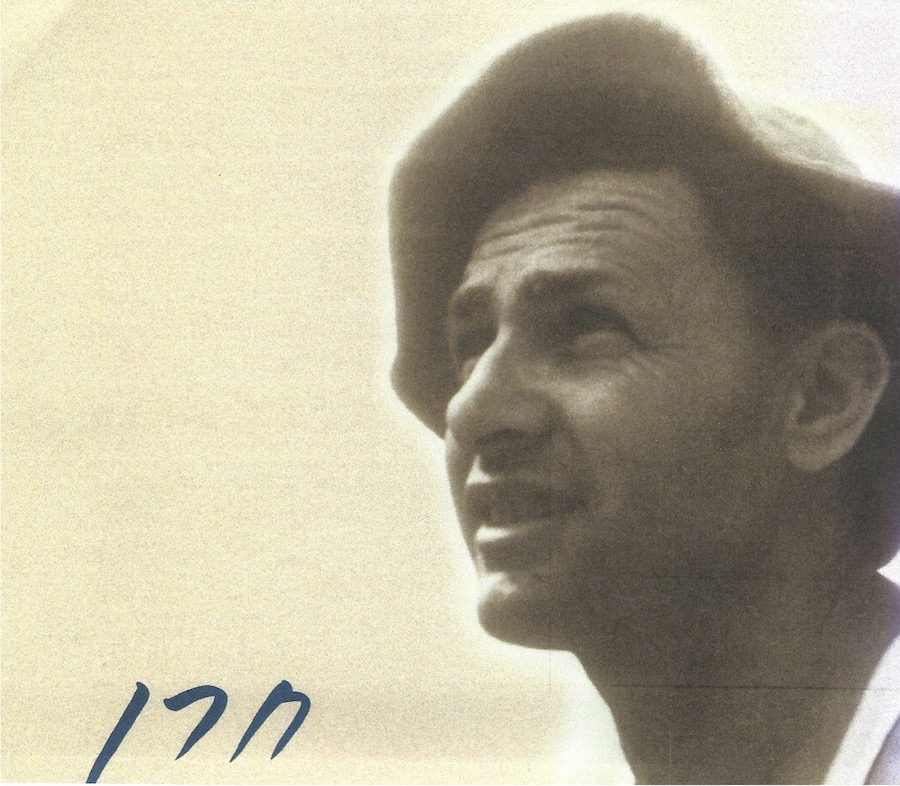
My youngest son’s namesake…
Translated from Romanian by my Grandfather Bert (1928-Present)
5690 1930
29 Teveth (29 Jan.)
Fifteen winters have seen playful butterfly-like snowflakes, since I have for the first time seen the pale light of a late sun of winter.
Fourteen springs have made the temperate flora to flourish and as many fall days have made the fall, since myself have appeared an atom in the ocean of humanity and in the infinite Universe!
I am now 15 years old!
I waited with deep emotions for this day, and deep sunny feelings from the depth of my soul. I gave it a colour, an important moment in my life as an adolescent.
And if a poet can depict by words this state of deep emotions, I could only try.
But the day has arrived and I have to keep the promise made to myself, and now to express it somehow.
I forgot the Hebrew date of my birth and I did not want to consider my birth date according to the Gregorian calendar, and after calculating, succeeded to determine the Hebrew date as 29 Teveth 5690.
The feelings overwhelming my complex soul are those of joy, satisfaction, encouragement, self-confidence and some superiority, to which I am elevated by a strong feeling (I hope) of love of all beings, but not in the present state, but rather in a more perfect way, harmonizing with my love of Truths, Justice, Peace, deep in my soul and, if necessary, to be revisited.
Now, at the age of fifteen, I can better realize my personality, which I will cultivate, and the role I could accomplish.
PAGE II
Because my ideal in life is the “creation,” for which I will fight, work hard, struggle, because I want to be a life force in the support of my people and, implicitly, all humanity.
Certainly an ideal originating from selfishness. It is the law of human nature: “Through selfishness to altruism.”
Be it that the fulfilment of this ideal will be hindered by normal but avoidable obstacles, or by a man’s and humanity’s hardships, I will not stop on my way to fight for the true future society. Nothing can stop; result will.
I desire it to myself (in Hebrew lettering and signed Ariel).
Today I tried to understand if “free will exists?”
Following research in the doctrines dealing with this topic of free will and determinism, it seems the conclusion is that free will does not exist. My opinion: “Will is a psychological factor of personality, determining the action of an individual.”
1 Shevat (30 Jan.)
I read “Owners and Slaves” by Maxim Gorky. He is admiring the proletariat whose understanding of the knowledge of its creative force, and harsh criticism of bourgeois society and of so-called well-to-do’s, convictions obtained resulting from his life’s sufferings and realities.
2 Shevat (31 Jan.)
I read “The Atheist Facing Death” by Dr. J. [name unclear]. “Not only the believer dies with hope, but also the atheist whose ideals become his religion.”
In the evening I went to the theater, the operetta “Akeidat Yitzhak” by Goldfaden. I liked it.
[Unclear introductory phrase:] “Only the common ideal ‘Palestine’ can help you. But for this propaganda, until the creation of economic possibilities in Eretz Zion, it is required to be cultivated in Galuth. And that as soon as possible.”
PAGE III
4 Shevat (2 Feb.)
On the side of the “Philosophic Testament” of Tolstoy:
Love! That is, in one word only, the teaching left to us by the “free spirit” called R. Rolland.
Love everybody, love “love.” Enhance your own moral. Brighten yourself and everything will become right. The material pleasures coming from egoism generate hate and quarrels between humans, while spiritual satisfaction resulting from selflessness unites people!
True! I love people. But love cannot become the creed in present society where a minority own and exploit the masses. Only when equality of living conditions will take place, because how can you love the ones who sap your power for their benefit?
Only the material well-being of the masses will bring their happiness and altruism.
And because I love all people, because I desire the good for all people, I have to fight against the present social order, to achieve a structure that allows “love.”
“There is only one solution: to love everything, to love the source of love, to love loving, to love God, to love for the love of the universe, and not for ourselves, but for the love in itself.” (Tolstoy)
A person who loved, but did not rebel!
I was at the movie “The Hunchback of Notre Dame de Paris,” after V. Hugo’s opus, with the extraordinary interpretation by Lon Chaney. The gratitude for Esmeralda made the hunchback go beyond any human feeling and become a beast, plotting against his owner. His death is the one of a true hero fighting for recognition.
5 Shevat (3 Feb.)
Referring to the chapter in “Nationalism in the West” by Tagore.
PAGE IV
Like nobody else until now, the great humanitarian spirit of India is rising against the horrid form of manipulation adopted by the European nations, which led to the major carnage that shook deeply the whole world.
According to him, Western nationalism, as it presently degenerated, means only the organized egoism of the nation.
“Europe got its human grandeur by the education of people still corrupt.” While Western spirit marches under the banner of freedom, the Western nation creates the chains of its order, the sharpest and most indestructible ever achieved in human history.
It is normal that Tagore, who lived and still lives in the spirit of Buddhist ideas (relative, because they existed before the castes and unfortunate pariahs, which have today disappeared due to Gandhi’s generous social spirit), and humane, should rise with elan, neglecting other aspects of today’s culture, against Western nationalism, and still suggesting a meeting between the West and the contemplativity of the East, incipient.
6 Shevat (4 Feb.)
I am reading “Dreamers of the Ghetto” by Israel Zangwill. It describes types of Jews which, following emancipation and destruction of the ghettos, thirsty for a new world, a new culture, not knowing to appreciate the value of Judaism.
But reality awakens them from their ignorance of the indestructible chain of Judaism, of the magnetism of its force (”A Man in Jerusalem” – Isaac Lewinsky), while the mystic renounces earthly life for eternal God ([name unclear]), or as in [name unclear], the young dreamer which tries to organize the Jews for self-defence against pogroms of Russia and who sees the most of people indifferent, closed on the old path of servilism, while the intellectuals who were supposed to be united are split even in the same family, which does not comprehend the situation and the stringent need of the Jewish community.
PAGE V
And the hero sees among the shooters which bombard the Jews’ quarters an enthusiastic youngster with Maccabean dreams [name or phrase unclear].
Israel Zangwill succeeded to picture the life of Jewish people after liberation, giving it sometimes an exaggerated mystico-philosophical, or alternative socio-political, image.
7 Shevat (5 Feb.)
Today, at the Museum, I played several chess games. I prevailed overall. The chess game awakes unknown ambitions, cold judgment, foresight and the feeling of victory in war (and it might be social, political, economic, cultural and generally human).
At the theater it is now playing “Melo” by Henry Bernstein, a colossal success of the Ventura Theater. Regrettably I did not attend, but I will try some other time.
8 Shevat (6 Feb.)
I heard about frictions from “Aviv,” “Nothing New on the Western Front,” “Vanity in Timidity,” Rosetta and Fany, good friends (according to Albertica). I am starting “The Cement” by Fyodor Gladkov.
9 Shevat (7 Feb.)
Reading “The Cement.”
10 Shevat (8 Feb.)
I finished “The Cement,” a true book and a sincere author. Without detours, Gladkov succeeds to picture the situation from social, political, economical, and philosophical perspective, developed in a state of chaos, but with final tendency of improvement.
PAGE VI
He is critical of bureaucracy, but shows, as Gleb Chumalov, the true conscious proletariat, militant, hoping for future clarification and betterment. And if some aspects have improved, R.S.F.S.R. could not destroy the bureaucracy which took hideous forms, which in “Confessions of a Lover” by [Panait Istrati?] describes a regrettable but very hard, if not impossible, to set right.
Gladkov describes also social evolution of Russian women who neglected the difficulties of return (happening in 1920-21), female attributes becoming truly working equal to that masculine. (Dasha Chumalova, Polia Mekhova.)
It is a very good work.
The new “army” of Russian contemporary intellectuals succeeded to attenuate the impression left by the Bolshevik monster regarding the bourgeoisie.
After noon, I was at the Hall. The Hall has become what it should be: a place for meetings. Some people believe that the Hall is only for convivialism; any other activity (as the reading of a book) is discouraged.
But the true purpose of the Hall is to create permanent and strong relations between the Scouts, with the help of spiritual discussions. I will strive to do that.
11 Shevat (9 Feb.)
The morning passed without realizing. After noon I go first to Mosheu to play chess and after we go to the Hall.
PAGE VII
At 6 o’clock we go to the debate. Dan will expose from the book “Die Juden in der Gegenwart” by Ruppin a few chapters, such as “The Process of Grouping of the Jews,” “Social Status of the Jews,” “Prior to Emancipation,” “Mendelssohn’s Current and Conservatives,” as well as a statistical chart of present social status.
Ruppin divides the Jewish people in four classes, or better said in four social levels tending to succeeding assimilation. Passing from the first level to the second is a step to assimilation; from the second to the third is the moment of assimilation; and finally the fourth is total assimilation.
We all memorized this statistical image from the first lecture.
Back home, I study for the test of Romanian language. I also read the pamphlet “Union Paneuropeenne,” written by the Pan-European Union led by R. N. Coudenhove-Kalergi, showing the economic and peace benefits of organizing the European States in an S.U.E., but not following the model of U.S.A. Not a dissolution, assimilation of the personality of the states, but rather economical cooperation through elimination of customs in order to prevent competition of the other continents.
“Dans l’histoire, aucun grand mouvement politique ne se realise sans paraitre d’abord comme utopie.”
I’m going to the “Circle” where Bloch-Blumental will make a presentation. Due to low attendance of youths, it was cancelled.
I managed to observe him from close up: blue eyes reflecting unlimited kindness, a physiognomy showing the care for those entrusted to him. “Un homme bon.”
13 Shevat (11 Feb.)
I followed at the meetings the issue of [unclear] (N.P.I.G.).
15 Shevat (13 Feb.)
(In Hebrew: Hamisha-asar B’Shvat.) I passed such a beautiful evening. “Odaha.” When I sung a Hebrew song as introduction, I started crying. The words penetrated me, convincing.
PAGE VIII
After the “Odaha” we started singing. We were happy as we had not been for a long time. We sang until one o’clock after midnight. Afterward I returned home (!?!).
When I came to the Hall there were few people, and afterward they all left and I was alone. It was a wonderful night, and although 13 February, it wasn’t cold at all, but even a warm breeze. The full moon on the blue ocean background, sprinkled with stars, proud, breathing, fantastic.
Sitting on a rock, I started singing alone, aloud, overwhelmed.
17 Shevat (15 Feb.)
After noon I will be going to the “Hall.” We are jumping. Ziva is very beautiful, like ever. Ester reads my palm: not at all vulgar; goodness; self-assured; suffering morally; intellectual and sentimental; life of hard work; artistical talents. Is that true?!
Apart: “The Japanese Nationalism” by R. Tagore.
PAGE IX
With deep and sincere admiration, Tagore speaks to the Japanese people, who have shown to the world that the East no longer dwells on the past like in a mausoleum. Japan did not imitate the West because the science they used is universal and they had to borrow the modernism of Europe and not their form of nationalism.
In my quiet writing of my views of “Western nationalism,” I said that Tagore neglected the spiritual side of Europe. But this is not true. In truth he is admiring it.
“I don’t want to negate the grandeur of Europe which is obvious. We can only love and admire with heart this Europe from which a limitless river flows in art and literature, a river of beauty and truth pervading countries and times. Europe whose gigantic spirit penetrates with unstoppable power all the heights and depths of the universe, containing in its awareness the big and small infinites, using all emotional and mental powers to conquer sickness, misery and sufferings that were accepted with resignation. This Europe finally who has forced the earth to yield more resources than it seemed possible, obtaining by goodness and force that nature was put in the service of humanity.”
Tagore is concerned about the new shape taken by Japanese nationalism which makes no effort to apply the brotherhood and spiritual equality of Japanese people in the new order, ready to follow Western nationalism.
Thoughts of Tagore:
“The worse form of slavery is getting discouraged because losing confidence in ourselves makes us lose hope for freedom. Progress must be judged according to its purpose.”
PAGE X
Only the spirit of a man aware of final success can overcome all hardships and direct light on feelings, and can accept the martyrdom for remote purposes that he himself cannot attain, but that should not be abandoned.
In the heart of Europe truly flows a pure river of love of people, love of justice and of sacrifice for superior ideals.
True modernism is freedom of spirit and not slavery. It is the independence of thought and action and not the designation of European teachers. It is science, but not its negative applications.
The greatest discovery ever made by humans is discovery of moral law: that humans get closer to Truth as they feel and recognize the others.
14 Shevat (16 Feb.)
After noon, I went out in the field. Very nice weather. I observed the sunset between the hills.
When I heard at the discussions that Borochov, at age 18, could quote by heart Hegel, Kant, Leibniz, I recalled the words of Julius Caesar, when he saw the statue of Alexander the Great: “At my age you have already conquered the world.” And still Caesar succeeded to get a place in history beside Alexander.
16 Adar (16 March)
A month went by since I have written last. What was the reason for it? During this month I was in a sort of contemplative state that totally absorbed me, not letting me express my observations.
PAGE XI
I observed myself; I observed the others. Void in intellect, void in character. None has self-imposed a direction to consider beautiful and truthful: “As it comes, it goes.”
For Purim, we wanted, like the whole village, to get costumed. It was not possible. But we succeeded after efforts and strong will to put together a historical grouping: Ahasuerus, Ester, Haman, Mordechai. Unfortunately, the result was not the one anticipated.
Purim has become today not a national festivity, a memory of a victory of the Jews, but rather a grotesque party, a day of total forgetting of Jewish achievement. Worst of all, the Jews have lost national identity. There are needed immense efforts and titanic work for the national awareness (that is Zionism) to become a reality for the majority of the people.
The Zionist propaganda is too weak to be able to resist the tendency of assimilation and the loss of a Jewish identity.
Suik left today, going to Montpellier. Our parting was quite icy. Why did he change so much, or might be I did not know him enough. Before leaving we had a conversation. He claims that the way he talks is due to his environment. I believe it is due to his temperament. Which of them? Time and experience will prove it!
PAGE XII
23 Adar (23 March?)
I am writing for last week, after Purim. I was deeply saddened by a situation that I could not oppose, and that was the deep break-up between myself and Dor. I didn’t believe it was possible in a sincere friendship as ours. Or, on falsehood one cannot build friendship. I don’t regret that the break-up happened now. Now I realize that Dor was not really sincere. (Hypocrisy?)
So far there was no clarification between us, both being ambitious and proud.
The work of “Kvutzat Kfir” has stagnated for a while. Itzhac is too busy and that reflects on our activity. What can be done? We will have to take care of it ourselves.
Can a perfect human exist? Now, in the spiritual and social world, there are so many opposing tendencies that a perfect human cannot exist.
If one will be considered a perfect being in Europe, it will not be considered perfect in India.
Perfect human will exist when spiritual and social reality of all humanity will be visible through a unified synthetic prism. But when will that be?
7 Nisan
I’m writing now for two past weeks, rich in events.
Thursday, 27 Adar, I was at Haller. While I was reading with Betty, Dor took “The Cement” and my beret and left. When, in the afternoon, I went to get my beret, I took advantage of a moment of Dor’s distraction to take “The Cement,” trying to tease him. In the evening I gave the book to Neimah without the knowledge of Dor.
PAGE XIII
Dor, noticing the missing of the book, thought that a customer took it and, without telling it to anybody, he bought another “Cement” and informed Neimah of that. Neimah told me the story.
Dor, as a follower of the break-up, does not tell me anything and informs only Mosheu about what happens. I played the game, seeming interested to find out where the new book came from. He is not telling me.
Thursday, 4 Nisan, under the guise of a fable with four actors—the bear, the wolf, the fox and the ferret—I show to Mosheu that I knew more than he thinks. Thursday, Friday and Saturday Dor shows an important side of his “noble” character. He knows how to hate. To answer to his hate I will only follow the directives of our great creators of “[Gemura?].”
Today I tell also Betty about my break-up with Dor. Mosheu is more attracted under the influence of Dor.
In these last two weeks, every evening, I worked on the translation of the poem “Hamatmid” by Bialik. It is very hard work. So far I have translated more than half.
Friday, the 5th Adar, I went to the theater to see the very interesting comedy, “The Phantom Train.” Never have I witnessed so much applauding. A bizarre show, wonderful direction and actors. The effects and interpretation succeeded to frighten all those present. When I listen to a train’s siren, it is like I hear “The Phantom Train.”
PAGE XIV
If the being and creativity of man would not tend to the social, to what good would be this minuscule “atom” relative to the infinite space and time? Even so, the individual as well as society have their value.
“Always keep the middle of the road and you will not be wrong.”
The romantic “Matmid” by Bialik represents the land of Israel, as well as the Jewish people.
When I read about the life of so many great people, I am thinking of who I am and who I want to become.
Love is the only answer to the problems of all humanity.
If you are missing an environment, create it from books.
We must find ways to prolong life as much as possible. Only then can we say that humans have achieved real progress in science.
17 Nisan (15 Apr.)
I recently read “Costia Riabtsev,” or “The Sovietic Student,” under the form of a daily diary of a Russian student, Costia-Weiden-Riabtsev. Ogniev describes the life of a youngster in a Soviet school, which can be selected as a model to emulate. Familiar with the psychology of the youngster, he succeeds to relate the life of Costia, indissolubly involved in the life of the “collective.”
PAGE XV
He is describing the passions, failures in hopes of youngsters who succeeded to mostly adopt the communist ideology.
But all ambition of Costia is not directed to great purposes, such as university, etc. As if it would be right to become a “proletar” to identify with the social class that he belonged to and for which he is fighting.
Through the relation between Costia and Silva, the author is trying to show what should be a right relation between boy and girl. The relation described by Sylvia is sometimes better than that on Costia.
The exposition of auto-administration of pedagogy, the relationship of students with teachers and school and with the working class, made me to disagree with all teaching institutions of bourgeoisie.
Neperov is the teacher who succeeded to create accord between student and teacher, between enthusiastic youngster and adult, but also becoming a victim of his opinions. It makes me think of Sergio from “The Cement”: “Quantitatively, it is average of species and qualitatively it is outside of good and bad”; “I believe that the revolution will fail.”
In “Costia Riabtsev” Ogniev is asking: “What are we living for?” I will try to answer. How many times was this question asked and many different answers were given. I will add my reply to the others because I’m trying to clarify my thoughts, my hopes, my needs.
PAGE XVI
To answer the question, “What do I live for?” I have first to answer an often more to the point question: “For whom do I live?”
I live for myself, to be able to live for my people, for my people as part of humanity, because an individual can find its value in relation only with society.
I live to acquire knowledge and values accumulated so far by humanity (as far as possible) in order to aid the development of my people, and implicitly that of society and humanity.
The fate reserved to the Jewish people makes me to participate, together with all Zionists, to the fight for social betterment on two fronts: the national and the social.
At the national: through hard work for the rebuilding of Eretz-Israel, that being the only solution to the Jewish problem—economical and cultural—by assuming the spiritual and moral values of old Israel and by continuity of national inheritance.
Recognizing that present social order is not a right one, the useful one, or the nice one, I will fight for social evolution or revolution—depending on circumstances—for socializing the resources and collectivizing production and consumption. Palestine being now in transition, social efforts are easier than in other places.
PAGE XVII
But now I am asking: Should I give priority in Palestine to national aspect or to the social?
Recognizing that “condition of production” appeared prior to “relations of production” and the position of the Jewish people and Palestine, I believe that priority should be given to the “national,” because only in a nation with solid ground will it be easier to achieve social changes leading to the final objective.
My creed in life will be:
“Work hard for spiritual and social, Jewish and universal values. Strive to improve social, economical, political and cultural state of the Jewish people: toward attaining socialism. Circumstances will create the possibilities.”
We will not truly feel the pleasures of life without first suffering. Nothing can be appreciated without relationship. But excessive suffering lead to hatred of people and of life and are discouraging an individual beyond redemption, even when pleasure and joy reappear.
Such a case is Martin Eden.
PAGE XVIII
Morale from our unit has stagnated. Disorientation is everywhere.
What is missing is “[Hebrew text],” without what nothing can be done.
All the day, at the Hall, people play only. “Kvutzat Kfir,” which is really work and not entertainment.
I intend to initiate now, while there is still time, a number of conversations. For Thursday I will initiate discussion about: Haggadah, Kabbalah, Hasidism, Haskalah, Ahad Ha’am, Bialik, Peretz, An-sky, Mendel, [Mocher?], books and others.
Mosheu is a good fellow, but not trying hard, as he confesses himself. Oringher could be a hard-working fellow. Segall is difficult to be moved.
I was thinking to model my diary after the one of Costia Riabtsev, but realized it was not possible. He is living the truth of reality applied to practice, while I, beside bare reality, am also thinking of practical application of new theories.
I observed something: It comes easier to read scholastic notions if I also read literary works. I will therefore adapt to necessities.
Today, I worked on the translation. I want to finish it this week. Enough written for today. It is past midnight (12:30).
PAGE XIX
15-21 Nisan
It is Pesach!……
Four thousand years ago a people of slaves, brutalized with hard labour, but hiding vital energy, have broken the chains of most odious slavery, succeeding to escape from the grip of the Egyptian Pharaoh.
But why is the exodus from the Babylonian captivity not treated as the exit from Egypt?
That’s because by exiting Egypt, those believing in a single God have become a people who acquired a collective conscience united by traditions, sufferings and joys.
And the Haggadah shows us the importance of the Exodus and all legends and traditions connected to it.
“And Moses, our teacher, has liberated us!” A man who has faced all adversities of fate and of the Pharaoh, who doubting first, did not hesitate, convinced of his calling in the name of a people persecuted for ages. And through his unwavering belief in his people he opened an extraordinary path for Israel.
And how many obstacles did he encounter: the opposition of the Pharaoh, the harshness of the desert, the reluctance of the people not used to the spirit of freedom, nature and humans! But led by his beliefs, he succeeded. And in the desire to bring a real people in a homeland, he did not hesitate when forced to trek for 40 years through the desert, allowing the old generation of slaves from Egypt to perish and a new generation to be born, young and vigorous, desiring of freedom and truth and new achievements.
And he succeeded!
And all the settlements, social and juridic laws, the Decalogue, are showing us how real, actual and material the concepts of Moses are. And how many have survived, unaltered to our times!
PAGE XX
Passover! The holiday of freedom and of the spring!
Flowers and budding, love and work, hope and confidence in the future!
20 Nisan (18 April)
David Zoller came to Bacau. Great joy for all. Loved even by those who have not met him. Good to the bone. Forever devoted to constructive effort for the common benefit of the people.
21 Nisan (19 Apr.)
In the morning, about 10-11 o’clock, we have planned a conversation with him. We are gathering at the synagogue and when we are more of us, we move over to Rabinovici where we will have the “conversation.”
For the first time in the Kvutzah (organization), in the open, everybody is presented with “sexuality” (sexual instincts).
I have to make a confession: I was interested and still am in the sexual problem in all aspects of its complexity.
From the first time the subject was brought up in the Kvutzah, I was convinced beyond any doubt in organization’s point of view: chastity and abstinence.
Regarding sexuality through the material, physiological, emotional, moral and intellectual angles, the only solution acceptable for a youth organization is abstinence.
But the sexual instincts prevail for everybody.
Knowing that it can be tamed only through physical and intellectual effort, I worked in that direction. I have sexual exercises; sometimes more, other times less.
David is asking me: Can the sexual instinct get to a point that I have a sexual relation? I answered without hesitating: No. As long as my convictions will not be shaken—and in present point in my life they cannot be shaken—and for me personally, me Ariel Haran, cannot be shaken under any circumstances as long as I live.
PAGE XXI
Feeling convinced of the moral value of abstinence, no matter of any critical moment of instinctual sexual [urge], I will not have a sexual relation irrespective of how much I would suffer.
Dor said first that he is not sure to resist sexual temptations.
David said: Sexual instinct is born in the subconscious. If you have the conviction of abstinence, you will not be able to pass inconsistent from apparition of critical moment of instinctual sexual to a sexual action, until reason reacts and then conviction will prevail, and not the instinct. Dor accepted.
We continued discussing about sexuality, a very important issue at our age.
Afterward, we were joined by Fishel Limpert and Betty. We played and frolicked.
Many times, I relate people’s actions to sexual instincts. Freud’s teachings are proving valid.
After noon we went to Mirca Lake and went around by boat. We met with Angelica’s crowd, the failed epicureans. Absurd.
David left tonight for Botosani. A good brother!
Today I finished translating the poem “Hamatmid.” Even though not perfect, the translation has good parts. I worked on it for a full month, every evening until midnight.
PAGE XXII
I was very happy with the outcome. A real reward for my effort. But what is the satisfaction of the “Hamatmid”?
22 Nisan
After noon, going to the Hall, I heard somebody calling. Knoll is showing me four Palestinians. One of them has a beautiful black beard, big eyes and a tall forehead.
“Salut!”
“Salut… Zvi Zohar…”
I am touched.
Colleague Zvi Zohar, member of Hanaga HaElyona, doctor in philosophy. He is going to “[Moshava Hanuchat?]” at Piatra Neamț.
I have to inform also the others. We part. I am going to the Hall. Fishel does not believe what I’m saying. After convincing him that I am truthful, he finally decides to go to “Hotel Palace,” room no. 10. We all go into the field. It is the last day of Passover and Odahal. Odahal!!
But it lacked the solemnity of previous Odahals. Itzhac is missing.
I would not have imagined that his absence from an Odahal could be felt so much. We were missing his important posture, his penetrating gaze, his clear words.
It is official! Hatzof has rejoined “the group” (Ken/Nest).
Finally, after almost half a year the river is back in its bed, the lost son has found himself.
While he was away from our movement he was active in Herzlia, forming a new group (Nest), but he was missing the satisfying environment.
I concluded that it is preferable to be a tail of a lion than the head of a fox.
PAGE XXIII
23 Nisan
Tomorrow we have an outing. We’re getting ready for it.
24 Nisan
The outing. We are leaving at 6 o’clock in the morning from the Jewish school.
We are 40 in all, something unheard of before in a “group” (Nest). At 9 o’clock we arrive at the junction toward Moinești. We descend in the valley and meet the “Avantgarde.” They did not find a good place for the encampment. We had to do the search and an hour later we found a place.
In the meantime I was also looking for a place. I climbed up along a stream and I found a good place covered with grass and surrounded by a small forest. But the claim of Dor that his chosen place is the better one (without having seen mine) made us to go to his: a site covered with grass but without forest, evident inferior to the one I found.
I am in the kitchen and preparing a wonderful “mămăligă.” In the meantime the people are working on shelters; ending at 2 o’clock; food is ready, we’re eating.
Also came with us: Hanan, David, Leicia, Klein and Hana. They settled in the place I had chosen. It is really the place occupied by the group of last year. (The “Avantgarde” should have been able to find it.)
We were roaming a lot on the hills. Izu and Carol (8 and 10 years old) have so far climbed twice the highest hill in the surroundings. Izu is scaling it for the third time. He is a good junior.
PAGE XXIV
We are doing Odaha. The Passover outing is a tradition which our group has done again this year. It is symbolic for freedom, identification with nature.
Then we are playing some games, and at 6 o’clock we start returning home, passing through the village Călugăra, reducing the length of the trip.
On the return trip Haber is telling us that the conclusion [Hebrew term] will take place in Bacau.
I am very glad. Certainly I will participate, as much as I wanted to go to Piatra.
I wonder why the Conclusion was moved to Bacau.
In Piatra there is a strong (?!) anti-Zionist movement led by Rabin and a certain Hascalovici. They issued a provocative manifesto against Zionists, leading to their arrest and confiscation of their identities (fake certainly), and liberated after the intervention of Zionist organizations.
Arriving to Bacau.
25-26 Nisan
The essay is relating to topics of education.
So far, education is done intuitively in our “association” (Histadrut). Now, there is need to give education a reasonable, scientific form.
The most interesting comments are those of Zohar and his last chapter, concluding the series with that of sexual education. Very important and interesting.
Sexuality is one of the main problems in our movement (i.e. Gordonia, part of Shomer Hatzair).
In the evening of 26 Nisan the Mantahim concluded.
I widely benefited from references and discussions.
PAGE XXV
13 Tammuz
There are almost 2 1/2 months that I have not written here.
It really does not matter if I don’t recall the exact date of some events. It is sufficient to know the period in which they occurred. And considering my feeling, the date is even less relevant.
The acrimony between Dor and myself has softened. The organization has demanded that from both of us. But friendship as it was will not be any longer. “Mortua est!” I cannot get close to him. And I would need it so much.
Mosheu has a close friendship with Joel, and often I feel out of place but never embarrassed.
There is very little work done in the organization. But sometimes there are free conversations. Generally the activity is lethargical, vegetative. One feels the need of some vital juice in “colonie.”
David came two more times to Bacau, once that we even made a trip to Mărgineni.
Most of the people went home on Saturday. The program of the walk was very good. Pity only that….
PAGE XXVI
We barely arrived there that we got a downpour of rain. After getting soaked to the bone, we went to the house of a peasant, in a sort of porch. It was so cold that we could not sleep, only dozing off a bit.
In the morning I came with Hatzair, Lica, Schalenischka and Irva. We came even though it was cloudy. The others said it is an act of courage.
The sites of Mărgineni (really a village nearby) are beautiful. The forest is grand, with paths and streams, clearings and dales.
In the morning we made a scouting in the forest. We went to the place for overnight camping and for evening play. Pity that….
The ones who remained at the base had conversations with David relating to Jewish problems.
We are divided in small groups, collecting items for our naturalist study, and afterward we’re returning to base and having a meal.
Nearby the base camp there is a hill on top of which there is a tree hit by thunder. There are prizes given to those running up to the tree. I am sure that I can do it. But no one succeeded!… Appearances are misleading.
Afterwards we all walk through the forest. The time is beautiful.
We divide into teams for play. The “flag” is in the hands of the Indians, led by Joel. I don’t want to dress in green leaves. I find it useless. Joel is stubborn. I am not giving in. I don’t play anymore.
PAGE XXVII
Sandu from Iuri’s team is coming close to the “flag.” As he is attempting to grab it, a mêlée is ensuing. It is difficult to decide who won.
We divide for another game. I was decided to divide in four groups for the four cardinal points. Me and Lipot are separating from the other, going to my corner. The others remain together and take prisoners. Joel and [Sumar?] finally take their flags. I jump in and take the flag. Veni, vidi, vici….
We play some more and then returning home.
I’m together with Betty, David and Rena. Betty says that Ester confirmed that she is protecting Dor and myself.
After that we discussed about “Costia Riabtsev.” David is leaving this evening.
We are going for a walk to Mirica. We are discussing about freedom. He claims that absolute freedom does not exist. It is not possible since man is determined in his thoughts and action. I conceive absolute freedom as freedom determined only by nature….
PAGE XXVIII
We are sitting on the grass. We remember past times in camp and I say that all happenings, trials and feelings are so vivid that I can now express them on paper.
The opening meeting, the evening conversation, the black cliff, the Ceahlău mountain, the Bicaz pass and floating on the log raft on the river Bistrița. [Hebrew text.]
The night campfire, the antisemites… the closing festivity, all those are fresh in my memory, and many others.
David promised to send me photos. Mementos!
We have a meeting, Kvutzat Kfir. I don’t know why Itzhac is talking to us (Hebrew). I am confused and don’t understand anything.
We are making another step. We are doing immediately a “conversation.” Dor is tempted: We don’t need a leader anymore to command us; we can handle ourselves; we are responsible.
Itzhac is also addressing us. He presents a totally different aspect of the problem.
We can achieve ourselves the cultural activities, OK, but what is happening with the sentimental aspect? That is the real question.
PAGE XXIX
Itzhac put the problem as it applies to the whole grouping, but not the veterans who just connected with our life and who will not be able to satisfy their emotional needs without a leader.
We are making a “conference” with Harzaer. We present him also the problem. We criticize Dor for having taken the responsibility for the group.
The issue of emotional connection and stating that not everybody can have a “confessor” like David Zoller. He is stating that he also encountered emotional problems to which he found answers from David. Now he will attempt to use the knowledge to the benefit of the group.
I resolved alone the issues that Dor did with help from David: sexuality, friendship, duties….
I have exams at school and “organization” activity is officially interrupted (?!). We nevertheless continue to meet at the Hall and debating different issues.
We are having a conference for reorganizing with Harzaer. We divide up in laboratories of science, Zionism, the Jewish problem, news from the Jewish world.
PAGE XXX
Lately we are meeting at Alfred, who is sick with phlebitis. Zoe Shah reads the “Literary Reality” and other magazines.
I am reading “Le Talon de Fer” of Jack London. A really good book. I call it the socialist ABC and prediction of realist history.
I also read “Antoinette” by Romain Rolland. Also a very good book.
Every day we are doing [Hebrew text], but I’m missing it because, for a week, I luxated my hand.
We are debating the departure to camp. I decided not to go to “[Moshava Tzofim?].”
I received from David a photograph and a letter in telegraphic style. I’m replying.
I want to go to camp only if Dor does. He has external objections, more complications than mine.
Roshcuta made laudable efforts to go to camp, but the devil intervened. She is a nice girl.
Sunday, 6th of July
We are having an assembly in the field! Anemic attendance, in all circa 30 people. We are criticizing current year’s activities. Not too great.
PAGE XXXI
Betty is talking ([Hebrew text]). I’m flabbergasted. We were not alerted, but I sensed that something will happen.
We are transferred to the [seniors] and are told about the duties involved in the new situation….
We make immediately a conference. I was not surprised by the transfer to “seniors,” that being a natural evolution. I nevertheless feel strong emotion. Dor is speaking about past, present and future.
We are leaving for Camp Iotzine.
I read “About Education” by Spencer, a really good study, attractive and useful.
We are going to Alfred. When leaving, I mention to Joel about the need to go to [Hebrew text]. He finds it a justified demand.
Tuesday, we went to Mirica. I continue debating with Joel the same topic. He said that the request of Dor to go to camp has encountered a strong opposition from the majority. Smul, Muti, Ghersm, Ester are against. He, Betty and Alfred are in favor.
This poses problems for myself as for him. He is making a sensational confession: We are regarded as a danger to the old members (Ghersm, Muti, Shmuel especially).
PAGE XXXII
They are afraid not to lose their position, as well as controlling us in case of parity.
Wednesday evening there is a meeting.
Joel said that the subject will come up and we will represent our position. Joel has lately reorganized the guide for man and mind, that works beautifully. Therefore he is not afraid to be replaced.
Joel is very sincere. I gained his confidence. But we are wondering what will happen with Mosheu.
He does not want to go to camp if I am not also going. Trying to satisfy both ends, I’ll go to both.
Today, 13 Tammuz
I read again about “physical education.” Yesterday I have read “The Red Laugh” by Andreyev: Terror, Craziness, Destruction. It was.
I’m going to Itzhac. Last week I sent a postcard to “The Medical Gazette” for a graphological analysis.
Today I read the reply: Optimism, generosity, elan, even level in thinking and actions. I’m satisfied.
PAGE XXXIII
14 Tammuz – 10/VII, Thursday
Yesterday we had a conversation. Joel is telling me everything that happened.
Itzhac and Betty are absent. Sichel Bek has decided not to go to camp because we have no experience (?!).
15 Tammuz – 11/VII, Friday
I’m going to Itzhac and I am telling him what happened at the reunion. He says that he was not informed about what was discussed, and therefore cannot form an opinion.
On other side he is asking me if I have money for both and why I cannot leave on Saturday. I’m telling him that I don’t have clean clothing.
Going again with Dor to Alfred. The discussion slides about communism. Dor states that the difference between socialism and communism is that communism does not allow cultural borders and national definition, while socialism accepts them.
I disagreed with this definition. I add that the difference is that communism demands the establishment of dictatorship of the proletariat. We are consulting the lexicon to see what is said about communism.
PAGE XXXIV
Socialism demands equality in community of “production” while the “usage” remains individual. In communism the “production” and “usage” are in common. These are economical facts derived from ethical feelings.
Politically, communism is not different of socialism because it requests institution of “dictatorship of the proletariat” (sic).
16 Tammuz – 12/VII, Friday
This evening the people are leaving to the camp. I am sad and depressed somehow. If I would have assurance to go to [Hebrew text] it would be all different. As it is, I will leave only one week later.
17 Tammuz
I went to “Raza.” I took “La Question sexuelle” by Auguste Forel. Hello! I finally found the book. It seems to be a very interesting work. It is analyzing sexuality from physiological, psychopathological, social and moral perspectives. It is a very substantial volume. Most likely I’ll be able to read about half before going to camp.
I’m talking again with Julica. Today Nuchen is leaving to camp.
18 Tammuz
Today there is debate (conversation) at the Hall. I’m discussing with Esther at the beach. She is against joining [Kfir Hagdola?].
19 Tammuz
In the morning I went to the beach. Gershon told me that he decided for the “conversation!”
PAGE XXXV
Our leaving to camp presents a totally different [problem] for Itzhac. He is wondering what is to be preferred?
[An untranslated passage with many Hebrew terms follows.]
It follows that we don’t go to camp, meanwhile. But Dor cannot leave until August, therefore to “[unclear].” But I feel the need of a [Hebrew word].
I ask Joel to raise the question at the next camp discussion. He is assuring me that he will do it.
20 Tammuz – 16/VII
Ester – the “discussion.”
21 Tammuz – 17/VII
I met Joel. He says that the question was left in suspension, that Itzhac is against for me to be allowed in “Mikhala” because I was undisciplined…. I did not have clean clothing in time.
PAGE XXXVI
22 Tammuz
I read the whole week “La Question sexuelle.”
In the evening I’m going to the movie theater, playing “The Psychosis of Love.” Tomorrow I leave to camp.
18/XII (Dec.)
Five months have passed since I last wrote here. Why? Just now when, as much as my inner life, as well as the external social one, were rich, tormented and exactly at such a critical age.
It would make no sense to try to explain the determinant factors contributing to the “disorienting.” I’ll try to understand the strongest and most determining factors.
PAGE XXXVII
It was first being at camp. I wanted to live there free, natural. I wanted to be pervaded with everything.
I wanted to identify with real life without noting my impressions, without searching for their cause and effect. And that is what I did. Camp, camp.
After I returned from camp I read “Comparative Psychology” by [Raber?]. In the chapter “Psychology of the Adolescent” I found myself, such as all adolescents find themselves.
And if “diaries” are an attribute of age, why should I do the same?
In my daily notes did I try to be original? When I realized that this is an illusion, I abandoned the writing “Insemnari” [notes].
PAGE XXXVIII
But now I realize that the notations are useful even if not original.
I am alone! I live in the Group, in the unit, but I have nobody close enough not to feel solitary.
Mosheu is friend with Joel and Fany. Bernard has his friends.
I feel the need of somebody to whom I could confess.
I was wrong believing that writing in this diary, I would get out of solitude. I was mistaken!
I need a human and not a notebook. The diary lets me open up to myself. No. I’m searching for somebody.
Will I be able to find someone? Maybe Ester. She showed me sympathy. I would like to be closer to her than I really am.
PAGE XXXIX
Now, when I formulate a plan for my life (upset with another element of age), I realize that I need her.
I wish to be a realist in my plans and to count on objective realities and subjective possibilities. I know them both.
That’s what I am looking for now and that is what I need: A major friendship. A friendship based on ideals, aspirations, objective and subjective realities.
OK! The way of life! [Hebrew text.]
***
Ester, Ester—! Your presence brings relief, warmth. I always long for you. I don’t care about the reason! (I enumerated above.) I aim rather for the purpose.
It is the time of ideologies taking shape.
PAGE XL
I entered [Hebrew word]. It’s surprising! Is it?
The group is left without energy. Last month, after a trip to Roman, we were joined by Paul and Jose.
With Paul I had two conversations in the village ([Hebrew text]). Both very interesting.
With Jose I had a technical conversation. We established an agenda for the Jewish problem and entering the “village” through Dor and Mosheu. Itzhac’s theory was abandoned.
PAGE XLI
I must create a grouping in III secondary class. It is difficult!
The ones who should enter the group have already passed through an array of tests ([Hebrew text]).
We started to work nice in the debate. The eyes of the eternal brother (?!)
I was the accuser. They found [Drato?] innocent (absurd).
On the 14/XII we have repeated the judgement for the commercial employees. They were absent and the only present was the Communist group.
He was again acquitted (the jury, not all), assuming he was ill. The second failure!
PAGE XLII
I will have another chance. I promise to work in detail. [Drotto?] must be condemned.
Paul was again in Bacau on the 13 and 14 Dec.
Shmuel has exited the unit (the nest, Ken). He disagrees with the ideology of Kibbutz (settlement), in as far as he knows it.
Shortly before leaving he wanted to give us a “[neerable?].” Together with Dor we fought against this attempt.
We have decided in the group to elect a guide among ourselves, for a month, in rotation. I was elected the first “guide.”
We are making ideological and some technical “conversations.” After myself, elected is Willy, a good man who has recently joined the organization.
PAGE XLIII
22/XII (Dec.)
Last week was Chanukah, the feast of victory of the Jewish people over the oppressors.
The feast of victory of the spirit over the flesh.
The blood of the Maccabees has soaked the land of Judea.
Two thousand years the Jews have not reacted with dignity to the atrocities of the world. They died in pogroms.
Two thousand years after the victory of Maccabees, the “Halutzim” (settlers) have reacted with dignity and courage to the bloody attacks of the wild Arabs.
They have not wavered from creative ways and, strengthened by strong belief, continued the rebuilding of the country of the people humiliated everywhere.
PAGE XLIV
The last day of Chanukah we went to the Hall and worked with Julica at decorations.
Hagigah was a general rehearsal. (Luckily [she] was not stubborn to bring her parents.)
We set the decor on fire. All our effort ended up in ashes—”Sic transit gloria mundi.”
Klein came to Bacau and partook in the festivities. Also Jancu Leibov.
We started a conversation about a Jewish state or a binational one. We decided to debate the issue one evening in the Hall.
24 Dec.
I’m staying home. Boring. Last night we had the “Conversation.” Few people showed up.
We went to Dor, who is ill. We will not make any “Conversation.”
Benjamin was readopted in the group (he was ousted following some events at the camp), conditional of corrective behavior.
PAGE XLV
He did not pay his debts from last year.
He is traveling to Bucharest at Christmas to have a good time. He intends to spend 1000 lei.
I’m telling him to first repay his debt of 150 lei. He says he “will give it.” We’ll pose his situation in the meeting.
I have pessimistic thoughts. I’m unhappy with the lethargy in which the masses are left by the Zionist and socialist movements.
I am thirsty for the energy and propaganda present in pre-revolutionary Russia, where everything is tormented, rebelling, forgetting of self and devoting body and soul to the movement, as appear the heroes of M. Gorky.
I sometimes feel the urge to agitate, to enlighten, to wake the masses from the cultural darkness of their life, to move them to action.
Everything shall be for the movement.
And I wonder if I am not selfish if I try my problems, if I want to create a new happy life, and I try to figure out how much I will be able to be active in the class struggle.
Lifelong struggle without doubts, struggle for which I feel the need and will fill my soul.
I want action, awakening, helping….
I’m waiting, time for preparing for action. Only in action can I find the way to continue the fight….
PAGE XLVI
This year we have a new teacher for German and Philosophy. A nice young fellow, Colben.
He is the coordinator of our class V.A. We provoked discussions on social problems. We realized that he is evolutionist and in good measure individualist. He is very pleasant.
For the test he assigned us to treat one of the subjects:
1) The moral value of the sense of duty.
2) The social value of the sense of solidarity.
I chose question 2. I got the mark 10 with mention.
Very good work. Here is a copy of the text:
THE SOCIAL VALUE OF THE SENSE OF SOLIDARITY
Humans are social beings who cannot live isolated. That was amply demonstrated by modern sociology as well as biology.
Humans could not and cannot live in isolation because, in fighting for survival, for obtaining the necessities of life, he instinctively felt the need to associate with others, equals, to facilitate acquisition of necessities of sustenance.
The common interest of members of a social group to facilitate the struggle for sustenance led in time to creation of certain connection—solidarity.
PAGE XLVII
Following the steps of human evolution, we notice that not only the economic factors led to cooperation, but also relations that they have same origin (the totemic clans).
Religious beliefs have also connected people through solidarity of men, remote grouping.
But not only economic reasons and awareness of same origins led to solidarity. Same historical fate and same living conditions have also led to connecting different people.
And the stronger the solidarity exists in a group, the more the group is progressing in economic, political, cultural, etc. fields.
Leon Bourgeois states that a solidarity of all humanity makes us responsible of the state of humanity.
We are responsible that someone is poor, because we haven’t given him the opportunity to earn his sustenance.
We are responsible for those who take the wrong turn and fall in abyss, because we have not attempted to lead them on the righteous way, on the way leading to moral social progress.
The stronger common interest is, the stronger the nascent solidarity is. The social value of solidarity is dependent of the purpose of solidarity.
PAGE XLVIII
But solidarity is not always caused by current interest. Solidarity can occur when common ideal exists, but that one cannot visualize happening.
And in that situation it is a revolutionary social factor, solidarity in this case having not only instrumental value but also a dynamic dialectical one.
And the more the solidarity is aware to those with same social aspirations, the more the solidarity will be of social value.
Consequently solidarity has a revolutionary value.
What is happening when different solidarities are clashing?
They fight, and recurring and history will go to the solidarity of the cause offering a higher level in the steps of human evolution. And therefore lays the great social value of solidarity.
Solidarity has social value (not only) when it is revolutive (but also) not conservative.
(The brackets are the corrections of Colben.)
That is the question I discussed with him, about solidarity. For an hour the whole class walked with him and discussed about social problems, communism, socialism, Russia.
Colben is intelligent, flexible, and very sly. He knows how to evade difficult situations. But we realize to which of our questions he has no answers.
PAGE XLIX
After my illness (I had phlegmonitis for two weeks in [unclear]), he came to our house, supposedly to discuss the sexual topic. So far, it did not happen, but I will wait.
What feeling should I search? The ones caused by ideas or spiritual or material relations between people.
Isolated in my solitude, I’m longing for friends. When will I find them?
I am missing the necessary friendship for my age, but I have the friendship of future great aspirations.
Present friendship would greatly influence my personality with which I will enter the struggle of life.
PAGE L
I do not want to be a loser of my adolescent ideals in my mature life. That’s why I will be a realist in expressing them.
Still lapidar!!!
29 Teveth 5691 (18 Jan. 1931) – Age 16
So many emotions, so many torments that it is difficult to put down on paper all my feelings, right now, at the most critical age of adolescence.
A year has passed since I thought that, objective and subjective, it would be a good idea to record my thoughts and impressions, believing that this will better achieve my spiritual evolution and that of others of the same age, and to understand their needs and potentials.
I belong to a youth Jewish movement, a movement that succeeded to practically synthesize the two major ideologies: the one universally human—socialism—and the one specially anomaly of Jewishhood—Zionism.
PAGE LI
Hashomer Hatzair has created educational values and ideology aimed at youth but applicable to mature people through individual accomplishment.
I can say that my soul and personality are in a continuous evolution and improvement.
The soul is asking for a lot and what it demands are not individualistic extravagances or personal egoistic satisfaction.
I want to belong body and soul to the collectivity at large. I want to dedicate my energy—that I aim to enhance—to the masses, that I want to guide to the most socially beneficial action.
I believe I still do in a creed: I want to regard facts only from a positive angle.
Considering the essence and not egoistic motivation, I will say that the aim is essentially altruist and therefore totally social. And that will always be my direction.
There are moments when I believe that I will never be satisfied, according to the demand and directions of my soul, until I would have created a work of the caliber of “The Ethics” by Spinoza, or “The Critique of Pure Reason” by Kant, or “The Capital” by Marx, or the “Theory of Relativity” by Einstein, or finally “The Theory of Proletarian Dictatorship” by Lenin, etc….
PAGE LII
And at the same time, reason certainly states:
“Truly, your thoughts are deeply social, but you also think of glory.”
I remember the satirical verses of Eminescu regarding the human thirst for glory (”Satire II”):
[…] keeping score at home, in addition to the top-down attacks against our currencies, demographics, religions, family structures, and general sanity – our dearly beloved private automobile is in clear […]