
As you’re all finishing up dinner and before we move onto dessert, I’d like to share a few thoughts with you all, a few reflections on this reflective occasion:
Moses… we’ve been talking a lot about him this evening, haven’t we, and we think we know him, right? One of the greatest and most pivotal political leaders in the Jewish tradition… a man whom we typically think of as virtuous, good, honest, even humble. A man who has to thread the needle to birth a nation, but a man at his core who is compassionate and generous, our saviour from Egypt, from bondage, not to mention the establisher of the Ten Commandments, and all those good things.
But perhaps we should look more closely… not to “rewrite history” or for “truth and reconciliation” or some such virtue signalling retroactive bureaucratic power grab, but to better understand ourselves, our people, and even the human condition more broadly in ways that certainly still apply today.
So we look at Exodus 32. The Israelites are freed from Egypt, and they’re all huddled around the base of Mount Sinai. God himself comes down, himself, not in persona form, but in thunder, lightning, fire, trumpets… Sturm und Drang you might even say. And he speaks in his own voice to the Israelites, the Ten Commandments. What’s the first commandment? NO GODS BEFORE ME. No idolatry. Ok fair enough, but people get scared. God is literally screaming in their faces. And they say, “Moses, you act as an intermediary. You help us mediate the situation.”
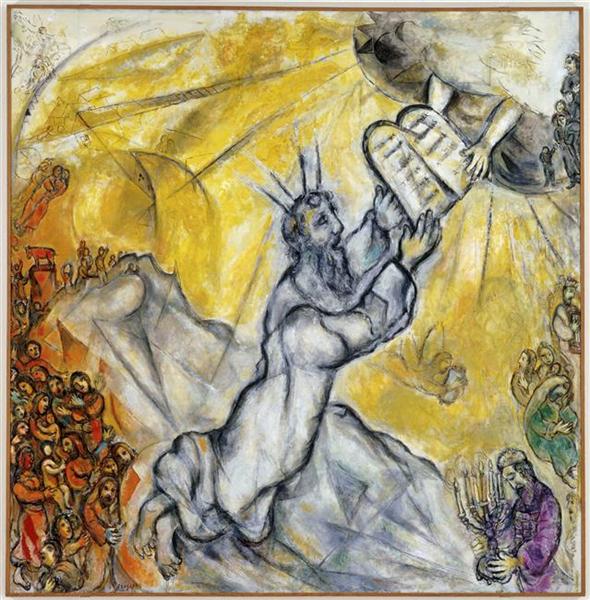
So Moses goes up the mountain for 40 days, and he creates these two tablets (or was it 3? ask Mel Brooksi …), with the Ten Commandments written upon them. But meanwhile, the Israelites, they get a bit impatient, and they’re like, “Why hasn’t Moses come down? What’s going on up there? Maybe he’s lost and forgot about us?” And so a few ringleaders start gathering up all the people’s jewelry, all the trinkets, gold, etc, which they melt down and shape into a golden calf, which they then start worshiping. And they start attributing their escape from Egypt and their freedom to this calf! God sees this, and he’s pissed, so he says to Moses, that’s it, I’m going to slaughter those idolatrous idiots, all of them. I’m paraphrasing a little bit here, but not by much, because he tells Moses, I’m going to kill every single Israelite except for you. And then unto you, I’m going to make a great nation.
God was going to make Moses a second Noah — start from a blank slate. And then at this point, Moses pulls out every bag in his rhetorical toolkit. “Did you do all those plagues and all that saving us from Phaoroh just to kill us here in the desert? Did you forget your covenant you made with Abraham?” Talk about a sales job! So Moses manages to get God to relent and he immediately speeds down the mountain, carrying the two tablets. At the bottom of the mountain, he too sees the idolatry, and admittedly, he starts fuming as well, boiling even, so he smashes the tablets on the ground, they break, which symbolizes the failure of law-giving ethics (which incidentally Socrates actually would’ve agreed with a thousand years later: ie. you can’t teach virtue, at least not in the way one teaches geometry, carpentry, or medicine! But where they actually diverged is that Socrates thought that virtue could only be god-given, but Moses understood that it could actually be inflicted, even scarred into a people. Which should tell you something about which is more “true” in the long-term, because the idealistic Ancient Greeks are long-gone and the pragmatic Jewish nation is alive and kicking, its layers of scars acting like a callous against the calumny and capriciousness of the world.)
Anyways Moses burns down the idol, and then he rallies the Levites, which is one of the few pure groups of Israelites who did not commit the idolatry (shout out to my sister-in-law Sarah). And then Moses says in Exodus 32:27,
“And [Moses] said unto them, thus saith the Lord God of Israel, put every man his sword by his side, and go in and out from gate to gate throughout the camp, and slay every man his brother, and every man his companion, and every man his neighbour.”
Basically, Moses ordered a massacre, pretended it was the world of God (noble lie!) and we are told that day 3,000 idolatrous Israelites perished. And it is this through this foundational and honestly brutal act that none less than Nicolo Machiavelli (the great realpolitiker of 16th century Renaissance Florence, of all people) elevates Moses as a the greatest of political leaders, as a true founder, above the likes of Julius Caesar and Alexander the Great. Everything else, parting the Red Sea, miracles, communing with God, just made Moses a prophet, or someone with religious authority. But Moses was so much more than that, because he didn’t fear culling the herd to make the herd stronger. More than just nice words and encouraging leadership, Moses knew how to wield violence, when necessary, and to the extent necessary; no more, but almost more importantly, no less. Some have even called this approach the “landmine management style“, and its effectiveness is inversely correlated to its present popularity.
Why? Why is that? Why do great leaders need violence to establish law? Why did Moses need to call a massacre? Machiavelli’s reading is that, what motivated the creation of the golden calf were the ringleaders envy of Moses, that he had this special relationship with God. But envy is this very unstable passion. And Machiavelli tells us the only way to kill envy is to, well, kill the envious.
If Moses had let the ringleaders live, they would have found new ways to thwart him, to thwart God, which would’ve inevitably caused God to smite all the Israelites and start with a blank slate again. So the Levites couldn’t just kill the few ringleaders (like pager attacks on Hamas leadership or drone strikes on IRGC leadership), they had to go further in order to ensure long-term success of the nation. This is the real world, after all, not the utopian world of humanitarians, moralists, and philosophers, but rather a world defined by people who are willing to do the difficult but ultimately the necessary thing.
But still… who says what “necessary” is? Like, doesn’t a 3,000 person massacre still seem a bit over-the-top? Even if it was out of a refugee population of probably 2 million souls if we’re to take the best estimates, that’s still a decent chunk! I mean, we have a lot of lawyers in this room and I’m sure most of them are wondering right now: why didn’t Moses just have a fair trial for the accused? Why the whole dramatic massacre thing? Well, if we take Machiavelli’s read on this historical event, we would see that cruelty and violence, if used with precision and in a spectacular fashion, is an effective, and sometimes the only pedagogical tool that works. Certainly more modern case studies attest to this truth and logic, such as Lee Kwan Yew’s treatment of drug dealers in the early years of Singaporean independence: what did he do with them? public hangings! What happened to the sales of illicit and poisonous drugs in his country? They fell off a cliff.
Now returning to the Bible: think about how corrupt the Israelites were at the of time after leaving Egypt. God himself… Again, Hashem himself shows up, and says in his own voice and says: NO IDOLATRY! Not even 40 days go by, and they start doing the very first thing he tells them not to. After all of that, after everything he did to take us out of Egypt, this is what we lower ourselves to.
Such corruption, it’s probably self-evident to say, necessitated much more than a fair trial of the guilty. So the command of Moses was as broad as it was because it wasn’t just about punishing guilt, but about teaching everyone else a memorable lesson through a public and uncompromising display of justice. And it was precisely because it was so excessive that it was so effective. Because at the end of the day, it worked! It worked. After the massacre, which you might even call a tactical culling of the herd at this point, Moses goes up the mountain again, communes with God, comes down with a new set of tablets, and successfully establishes the laws.
All of which paints a picture of the great Moses that we don’t typically think of during Passover, but perhaps its this more holistic lens that’s worth considering in our own time, because when we look at what we’d many of us would consider the “corruption” of the world’s current leadership, when compared to the ruthless and blood-soaked commitment of Moses, what we have today actually starts to look a lot less serious, a lot more performative, and therefore probably more transnationally-aligned than we’re lead to believe.
But perhaps that’s just because we’re in the maintenance phase of our nations now, and because now we’ve developed more comprehensive “narrative resets” instead of out-and-out massacres, or because it’s only foundings that are quite so cut-throat. I don’t know for sure, but I do know that Moses is a more complicated figure than I understood him to be last year, and hopefully this has shed a little more light in that direction for you all as well.
Chag Pesach Sameach.
[with gratitude to Johnathan Bi for catalysing the mosaic research]
[…] unsustainable car-dependence associated therewith. Parking requirements were never handed down from upon high, no matter how they’re treated now, and in fact they’re just 20th century relics […]